
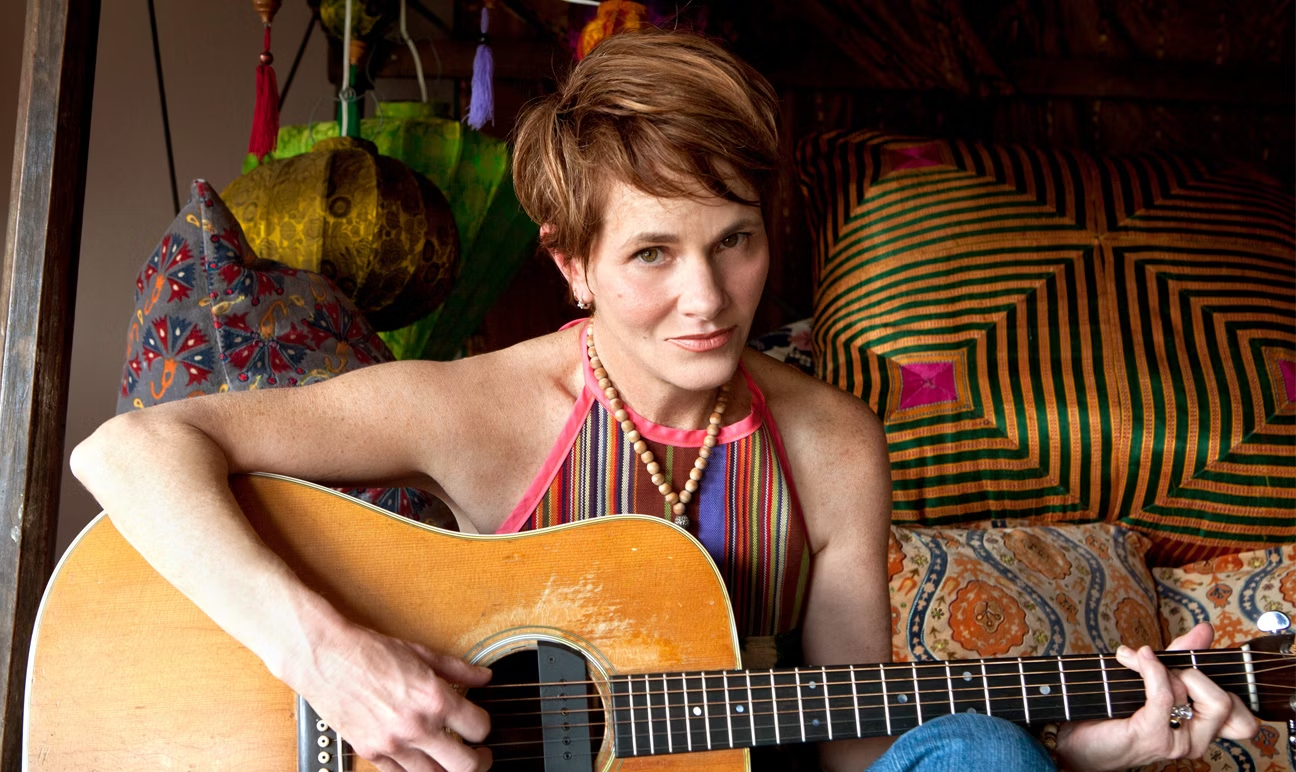
—By Lydia Hutchinson
I remember the first time I heard Shawn Colvin. It was 1990 and I was at a now long-gone haunt called Laurel’s Oyster Bar on Nashville’s Second Avenue, sitting at the bar having a drink and visiting with a friend. There was rhythmic, acoustic music accompanied by an incredibly beautiful voice coming through the speakers that was so compelling I completely tuned out my friend’s chattering and asked the bartender who was singing. He reached behind him where the tape player was and handed me the cassette cover to Shawn Colvin’s Steady On. I don’t think I’ve ever had an album move me the way that one did … and still does.
Three years later I had just launched Performing Songwriter magazine, had no idea what I was doing, but had somehow landed an interview with Shawn for the second issue. It was June 1993, and she was touring behind her new release Fat City. We sat backstage at the Telluride Bluegrass Festival and I remember being so nervous. But she was wonderful and honest and even told me she had read the first issue of magazine cover-to-cover. And before she got up to join Bela Fleck and the Flecktones onstage, she grabbed my arm and said, “Lydia, no matter what happens next for you, you’ve already accomplished something huge; just remember that.” And let me just say, I held on to that sentence for the next decade and a half like it was a lifeline.
I interviewed Shawn several more times and she appeared on a total of three covers over the 16 years of Performing Songwriter’s life, and she was always as great and forthcoming as that first interview. I thought I’d go back to that initial meeting in 1993 and the conversation that appeared in the now rare second issue. On that sunny summer day we were both in our 30s, and the path ahead was lined with dreams, possibilities and all that was to come.
Did you always want to write, or were you more comfortable playing other people’s music?
No, I think I always wanted to write. I wrote a lot when I was a teenager and was learning the guitar. And I’ve always been a good chameleon — I can really cop another person’s vocal thing. I learned a lot of people’s guitar styles—obviously, because that’s a good way to learn. But I wasn’t endowed with the kind of creative gift in my opinion. And the music I wrote then wasn’t really good; it was derivative. Maybe some good melodies here and there. But I did write. I mean as soon as I picked up the instrument I wrote 10 or 20 songs during the first year I was beginning to play. Then I just put up the writing. I don’t know why, but I did.
When did you pick it up again?
I didn’t really write again until I moved to California in 1979 and was in a quandary about what to do with my life. I was playing music, but to pass the time I would write snippets of things, they never came to anything, I never finished anything. Then I moved to New York in 1981 and met John Leventhal who had a band that was doing really sophisticated Steely Dan-esque kind of pop music. I loved the way they sounded and I began to write with him. He gave me music and I started to write the lyrics. And again I would be loathe to play any of those songs for anyone. They were not very genuine. But the relationship with him kept me at it because where I would falter he would push and vice versa.
When did you start writing on your own?
There was a breakthrough after four or five years of this where he gave me a track of music and instead of just writing the words over his production, I took his production and transposed it to the guitar. I dropped my E strings to D, a la Richard Thompson who is my second wave influence—Joni Mitchell being my first—and made this song into kind of a droney folk groove and I wrote “Diamond in the Rough.”
Did that open the door to your own writing style?
Yeah. That seemed like something I could really stick with. It was the first song of that style. And from that came everything else that’s on my first album. From that door opening and that stumbling upon my voice, if you will, came a system, a security, a net, that I could fall into and go and do something that I really did think was unique to me. And it definitely had to do with being confessional and personal.
Do you feel somewhat exposed by the personal nature of your songs?
They are personal. I sometimes feel as though I should apologize for that, but I’m too quick to negate myself as a songwriter … that’s part of what’s taken so long (laughs). I’d like to push myself and challenge myself beyond it, but it’s been enormously gratifying for me to write this stuff and my motto is stick with what you know. I didn’t have it in me to paint fictional pictures. I think that when you do that you’re going with things that have to do with you anyway. But I didn’t have the skill to make an interesting story, and I don’t know that I do now. But what I did have was a strong feeling of where I came from and where I was. And it had been a struggle. Part of me wanted to document that. I also just needed to express it, and I had really gone through some things and come out the other side. I was just moved to shed light on that.
Are you comfortable singing those songs to such a large audience?
I think the thing that has made it possible for me to write personal songs and sing them year after year is the sensibility for good writing. In that just opening your veins all over the paper is not necessarily going to be interesting. I wanted to speak to people. I was interested in being good and in moving people, not just “I’m going to say what I want to say.” So there’s a poetic aspect to them. Some songs I would just go way overboard on the emotion and then I’d have to rein it back in to make it accessible. You have to watch for a twist that you can put in or a way that you can make the point in a more unexpected way. So it’s not hard for me to play the songs. There’s an artistic content to them that satisfied me to the point that … they’re nice pieces. You don’t have to know they’re about me, you know. I wanted people to be able to sing them themselves.
Do you use rhythm a lot to get an idea for a song?
Yeah. If you get a groove going and you kind of say nonsense over the groove then some words come out that you couldn’t have predicted. Some you keep, some you don’t. “Cry Like An Angel” was written like that. I would go down to this pond in North Carolina every day just bopping along to the rhythm of the song and I would do it over and over in my head. I had tons of words and most were thrown out, like I had the word mortician in that song (laughs).
So it’s a matter of just flooding the rhythm with more lyrics than you could ever use and then weeding them out and making a story out of it. Because when you just start free-associating like that over some rhythm you end up not really talking about nonsense, but talking about yourself. It’s wierd, it’s cool, it’s scary, you know? This stuff comes out and you go, “I haven’t thought about that in years,” but it’s you. So it’s kind of a cool way to write. You end up having a perspective maybe that’s not so forced. There’s room for things to creep in that you couldn’t have thought of.
What is the background of “Kill The Messenger”?
It’s about Jane Siberry from Toronto. I went to see a concert of hers at The Bottom Line and it was one of the best shows that I’ve ever seen. She’s a great woman and performer—a bit of a Peter Pan and a bit of a seductress and has the great ability to combine whimsy and compassion. She’s quirky but accessible. And her show was theatrical in a very accessible, warm, wonderful way. I walked out of that show going, “Well, I should just hang it up.” And that’s really great for an artist to feel (laughs), it really is—it pushes you.
On her record called The Walking she thanked her songs for being there. You know, for just always being there. And “Kill The Messenger” is kind of about writer’s block, and it’s a sibling of “The Story.” It’s about feeling pulled down and used by people. It’s just somewhat of a bitter song. And somewhat of a plaintive song about wanting to feel the wonderful feelings of clarity and forgiveness when you’re at the best of your human nature instead of your worst, you know. Your worst being full of envy or hatred or greed or self pity. And I used her much like I did my sister in “The Story” to just sort of be a character to appeal to and in this case one that could sort of understand my plight and maybe harness the muse more easily than I.
What was the writing of “Poloroids” like?
It probably took a year. I got the first verse on the way to therapy—I was on this bus and it just came: “Please no more therapy/Mother take care of me/piece me together with needle and thread,” and I just went “Whaaa, thank you!” It had a cadence to it that was really infectious, kind of sing-songy and I just spent a lot of time getting involved in the rhythm of it and jotting down anything that came into my mind. And a lot of it was trash and a lot of it was funny, and a lot of it was applicable.
Did you really dream the last verse?
Yeah I did. I had this dream where this couple wasn’t walking a plank off of a ship, but they were walking a plank over a huge excavated hole in the ground. And they were totally in love, it was the sweetest damn feeling, you know? And he walked out first and she took a poloroid, then she walked out and he took a poloroid as she held up this flash card type of thing that said “Valentine.” The good will between these people must have been something that I was striving for because I had had relationships with a lot of ill will (laughs), which just seems so wrong, but it was in my life.
What about “I Don’t Know Why”?
I wrote it when I first moved to New York. I was on a subway and I wrote the whole song in my head. I felt very lonely and horrible at the time. I had this idea of what I would say to a baby and I’m sure it was more of an attempt just to console myself. The idea to make up something to comfort a child is probably what eased my depression at the time. I just wrote the whole thing really fast in my head, music and words, and didn’t even play it for months.
Then a friend of mine came to town and asked me if I’d written anything and I played that song. But because I didn’t write—because I was kind of invested in the identity of not seeing myself as a writer—I just didn’t consider it a real song (laughs). I just thought “Everybody makes up rhymes, everybody writes little poems, this is just a simple little thing that I wrote and there’s no need to call attention to it.”
What has that song done for your career?
I owe a lot to that song. It was like a gift. I hate to be cosmic about it, but that’s the truth. I mean it dropped into my lap. Around 1985, when Fast Folk Musical Magazine asked me to do something for them—and that organization is for songwriters—that was the song I had. In Boston there’s a lot of college radio, and they got ahold of that album and started playing my song. And I got a following in Boston based on “I Don’t Know Why.” So instead of playing bars for the money, I was lured to make this trip to Boston every three months to a club called Passim where people came to hear me play, and hear that song. And every time I’d go back to Passim I felt that that was an audience that wanted to hear what I was writing so I always tried to have another song finished by the time I’d go back there. I guess it was even more important than “Diamond In The Rough” because I was made to feel welcome in the songwriter’s field through the people in Boston that listened to those radio stations.
How did you develop your very distinct vocal style, and the way you blend it so perfectly with whatever you happen to be doing on the guitar?
I don’t know that I have a distinct style. I truly don’t have any perspective on that and when I hear myself singing back it’s still difficult. I have a vague idea of what you’re talking about and it would be easiest to point out the two main influences that I’ve had which are Joni Mitchell and Richard Thompson. Both are very strong guitarists and melodicists and singers and do intricate and interesting work as performers who accompany themselves. And I have a strong identification with that. I kind of consider myself as a singer first and foremost, but something that really helped me come into my own is that there’s not a separation between me singing and me playing the guitar. The two together were something where one fed off the other. I worked hard at developing a guitar style that felt good and also would work to entertain people over a long period of time all by myself. Something interesting and strong.
What about the way you tend to leave the melody and take a song in different directions?
That’s just something you have to feel. As a matter of fact, one of the dumber things my manager said was “Stick to the melody, I know you’re really great at improvising, but stick to the melody until the people get a handle on it,” (laughs). But I can’t. And I’m glad it still works, and it’s just something that I feel.
What advice would you give to a struggling songwriter?
I don’t know anything to say but be true to yourself and believe in what you do and stick to it. Because if you’re like me, you wouldn’t want to bend yourself around so much to please someone, then get somewhere with it and then have to live with it. So if it’s good for your soul and it’s making you happy, stick with it. Just don’t give up. I’ve never seen someone fail or miss out who wasn’t kind of pushing ahead with the best of intentions and with the belief in themselves. If you’ve got a goal, a dream that really suits you and you put it into motion, it generally takes you to somewhere. You’ve got to be willing to see where it takes you, and just enjoy the ride.
—By Lydia Hutchinson
Excerpted from Performing Songwriter Issue 2, Sept/Oct 1993
Shawn also appears in:
Performing Songwriter Issue 21, Nov/Dec 1996
Performing Songwriter Issue 52, Mar/Apr 2001
Performing Songwriter Issue 96, Sept/Oct 2006







0 Comments