
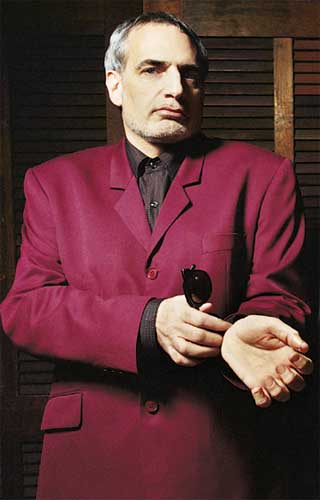
 —By Russell Hall
“Well, you know what they say: A little bit of sugar helps the medicine go down.”
So says Donald Fagen when asked about the subject of couching dark humor in upbeat music and melodies. As with all three solo albums—1981’s The Nightfly, 1993’s Kamakiriad and 2006’s Morph the Cat, Fagen sports an abundance of that approach. The methodology is familiar to fans of Steely Dan as well.
Fagen elaborates further about his solo work: “Somewhere in the middle of making The Nightfly, I realized the songs seemed to be from the viewpoint of someone approaching adolescence. Then, when I was doing Kamakiriad, that record was kind of about mid-life. At that point, I realized that someday I would have to conclude with a third album about the later stages of life—or the beginning stages of death.”
In the following 2006 interview by Russell Hall, Fagen discusses a multitude of factors that have shaped his work thus far. He also reveals, surprisingly, that he’s only recently come to terms with his chosen occupation.
Novelists sometimes say that as they get older, writing becomes more difficult, because they know more about the process and they’re more cognizant of what they might be doing wrong. Is the same true for songwriting?
Yes, it is. And there’s also more stuff I don’t bother writing down, because I already know that I might think it’s good for a month, but then I’ll throw it in the garbage. I can tell more quickly when things aren’t any good.
Arrangements are obviously very important to what you do. When you’re writing a song, do you hear arrangements in your head?
Sometimes I hear some aspects of an arrangement, but some of the details come later—especially in the case of horns. I might know the spaces where things will happen, but not exactly what’s going to happen. The horns are usually the last piece to be written.
Why is that?
Well, I take advantage of the fact that I’m working on tape. I could write horns before anything is recorded, but I wait until the vocal is there because the vocal sometimes changes during recording—the actual shape of the melody, or the shape of the phrasing. I would rather hear exactly the way it’s going to be, because I like to write the horns around the vocal, and make sure they don’t conflict with the it or with various other things that happen on the track. The horns end up integrating better with the track if I do them last.
Do the players have freedom to improvise?
Yes. Usually keyboard parts are notated the most severely, and bass lines sometimes. Guitar players usually have the most freedom, although once they start playing a part, I’ll tell them what I like about it and what I don’t like about it.
Humor is obviously very important to you as well. There was that period in the late ’50s and early ’60s where jazz, literature and stand-up comedy more or less converged. It seems the fact that that happened is something you took with you. It’s coursed through your work from the beginning.
Yes, for sure. I think there’s kind of a spirit of satire that started in the ’50s and ran way through the ’60s that I really connected to. You can actually hear it in the ’40s as well; I think you can hear it in Charlie Parker’s music. It’s almost a kind of defensive stance against the racist world that he lived in. But I think the fiercely conformist, rigid ’50s gave birth to a lot of satire in the margins of society. You can hear it in the jazz, and in the satirical comedians of the time—people like Lenny Bruce and Mort Sahl. And there were actually some musical comedians like Tom Lehrer who used to write these very funny songs. That kind of thing eventually evolved into things like Frank Zappa’s music. There were also some very funny science fiction writers who knew how to use science fiction to comment on the present. Frederik Pohl and C.M. Kornbluth, for example. Space Merchants and novels like that were very good social satire. Philip K. Dick could also be very funny, and Henry Kuttner as well.
There was a subversive quality to a lot of what was going on.
That’s definitely true for a lot of the science fiction of that time. I sort of grew up with that. I was a member of the Science Fiction Book Club, and they used to send me these novels and stories. And then in the late ’50s and early ’60s there was a whole school of black humor—straight novels with very dark humor. Kurt Vonnegut, early John Barth, Thomas Berger, Philip Roth, Bruce Jay Friedman. Walter [Becker] and I were both fans of that whole spectrum of stuff. And then there was the more Beat stuff—like Lenny Bruce and Lord Buckley. That all got thrown into the mix.
Of course what’s interesting is that a lot of people don’t pick up the humor at all. It’s a bit like pulling someone’s leg, where they don’t realize their leg is being pulled.
For sure. A lot of it is sort of a musician’s sense of humor. To this day, there’s a certain type of musician’s humor that civilians might not get.
That also keeps the songs from becoming novelty songs. Is that something you’re cognizant of trying to avoid?
That’s actually something Walter [Becker] and I discussed, relative to Steely Dan albums, too. Essentially the question is, “How funny do you want to be?” We try not to let the songs become too much of a pastiche or parody. We don’t want to turn into Weird Al, or even Frank Zappa. I think the songs work on several levels, and I don’t want to lose any of those levels. I think we have succumbed to parody-type stuff on occasion, and I think it hurts the song. I want them to work on a first-degree level.
And that applies to the music, too. I don’t want to make music that’s bad on purpose, just to be funny or to make a point. There’s a very thin line between what we do and straight comedy. Sometimes we have really funny lines, and we actually take them out and replace them with something that’s still funny but more subtle. If something’s too funny, you get listening fatigue; it starts to lose its meaning if it’s too powerful.
There seems to a bonus benefit to the body of work you’ve created—both in Steely Dan and as a solo artist—which is that it isn’t tethered strictly to a youth component, in the way that most rock ’n’ roll is.
That’s true. We’ve tried to be honest about what was around us all along, but we’ve been lucky in that sense. We’re lucky we’re not tied to some sort of adolescent posturing, or anything like that.
It’s an obvious thing to say, but it’s also true that you were fortunate to come up when you did, at a time when things were more open—particularly on radio—and people were testing boundaries.
Absolutely. We snuck in during a small window of time when people were willing to play unusual music on pop radio. There were just a few years, from the beginning of FM radio as a pop medium, when disc jockeys could choose their own playlists.
William Burroughs wrote a book called The Third Mind, where he posited the notion that when two talented people are thrown together, it gives rise to a third spirit. Do you subscribe to that?
Well, I can only say this: After a while, whenever Walter and I would get together, I think it’s true that a collective personality would appear, through the songs, that was neither he nor I, but some kind of other entity that was the narrator of the song. Maybe that’s not the case with all of them, but generally speaking that’s true. The narrator often has a certain personality that isn’t the most likable personality in the world, but it’s usually an interesting one.
You’ve said you didn’t accept yourself as a performer until very recently. By that do you mean the whole gamut of the profession—as musician, songwriter and entertainer?
Yeah, the whole gamut, really. People of my generation—and of my particular subculture—had a lot of trouble accepting a role in society as definitive, or deciding to be something for keeps. For me, maybe it was easier because I knew what I wanted to do at a very young age. But acknowledging that that’s what I am was difficult. I had trouble accepting other people’s perception of it, or something like that. Maybe it has to do with the fact that when we were young, part of the idea was to be free, in your mind, from stereotypes, or from the idea that you had to take on any particular role. There was something about that idea that narrowed your possibilities. And there may have been something masochistic about that in the long run.
Masochistic in what sense?
In the sense of not acknowledging that I’ve done this for a long time, and that I’m good at it, and that at this point maybe I should pat myself on the back a little for sticking with it and being a professional. Withholding that kind of acknowledgment to yourself maybe becomes masochistic, at some point. In other words, you may tell yourself you’re not going to get stuck like everyone else does in defining yourself by your job, but the fact is that that may just be a cover up for your own masochism.
—By Russell Hall
From Performing Songwriter Issue 92, Mar/Apr 2006
Steely Dan cover interview in Issue 44, March/April 2000










0 Comments