
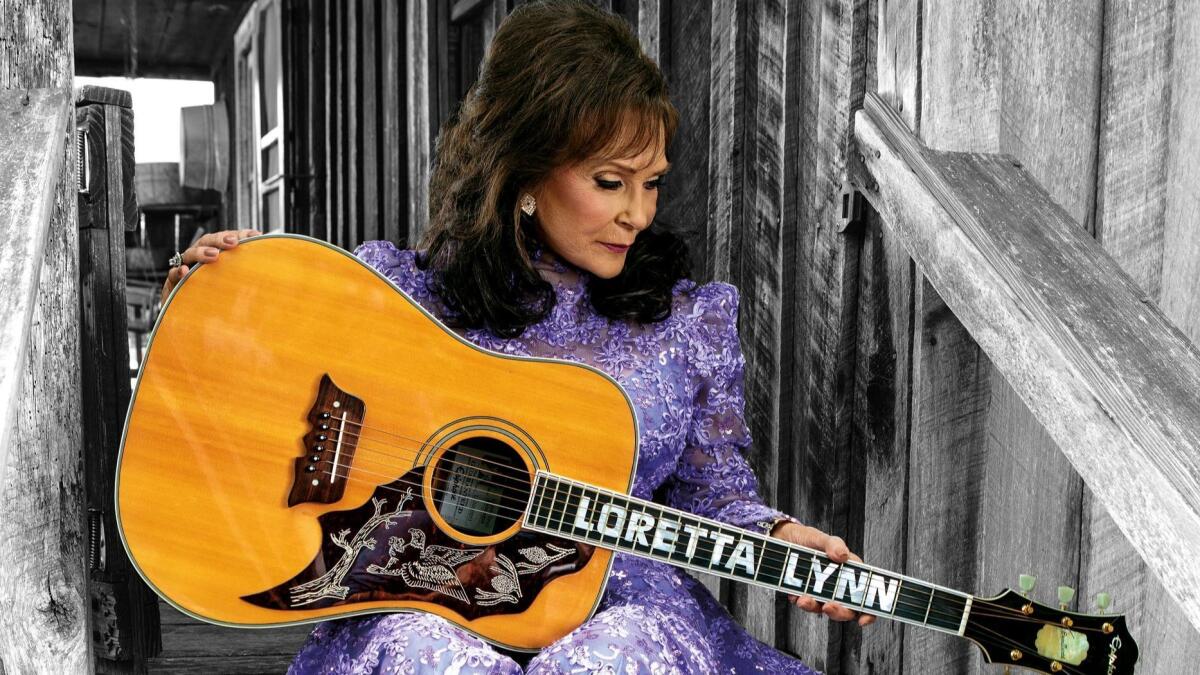
As the first line of her signature song goes, she “was born a coal miner’s daughter” on April 14, 1935. Raised in Butcher Holler, Ky., Loretta Webb was married at 13. By the time she was 19, she had four children. This hardly seems like a promising start for a successful life in music. But in 1960, at the encouragement of her husband, Oliver “Doolittle” Lynn, she began singing in bars. Over the next 40 years she transformed herself into one of country’s most beloved and important artists. And on classic songs such as “Fist City,” “Don’t Come Home A-Drinkin’ (With Lovin’ On Your Mind)” and “Your Squaw Is on the Warpath,” Loretta stepped up as the first in that genre to write from a strong female point of view.
“I was the first one to write it like the women lived it,” she says. “I guess I was different in writing about things that nobody would even talk about in public. I didn’t realize that they didn’t. I thought, ‘Well, this is what’s going on. I’ll write about it.’ I was writing about life.”
“Honky Tonk Girl”
I didn’t know much about a honky tonk girl. I was playing a little club in the state of Washington and that’s where I seen things, and that’s how I got the “Honky Tonk Girl” song wrote. It was about a girl from Missouri that would come out and hear me, and she’d sit in a booth by herself and she would cry. When I’d get a break, she’d ask me to come down and sit with her. I was real bashful, but I’d sneak down there and sit with her, and she told me that her husband had left her and she had nine kids. She’s the one I wrote “Honky Tonk Girl” for. I just have to put myself in the mind of that person that’s going through that while I’m writing.
“Your Squaw Is on the Warpath”
Daddy always called Mommy a squaw because she was part Indian. Daddy was part Indian, too. Both of my great grandmothers were part Cherokee. Daddy always called Mommy that, and Doo always called me that when I would go on the warpath. I’d get mad about something and he learned when to run (laughs). He knew that everything I could get my hands on, I would throw. He called me squaw a lot. One night, after I’d done four 30-minute shows at a little club, I got into my room and I thought, “I’m gonna write a song.” So I wrote “Squaw.” I called home and I didn’t realize that it was three o’clock in the morning. Doo being a farmer, you know, he went to bed with the chickens and got up with them. So, it’s three o’ clock in the morning and I woke him up, not thinking. That was me. Not thinking. I said, “Doolittle!” He said, “What?!” I knew right then I’d done the wrong thing. I said, “I wrote a hit song!” And I started singing “Your Squaw is on the Warpath” over the phone. He hung up on me about halfway through (laughs).
“Fist City”
I come up with the title first. I wrote that about an old girl who tried to take Doolittle away from me. I was in the hospital with pneumonia or something, right after I’d recorded the song and it was out. And the nurse come in to give me a shot and she said, “Oh, I believe you know my niece.” I said, “Who’s your niece?” She told me and I thought, “Oh my God.” Doo’s girlfriend was the niece. This nurse is fixing to give me a shot. It scared me to death (laughs).
“Dear Uncle Sam”
I get a lot of requests for that now, because of the war. When the Vietnam War was going strong, me and Doo was out on the road one time, taking the records from here to there, and I said, “I hate hearing about that war. Let’s change the station.” He said, “Why don’t you write about it?” When he said that, I had my pencil and paper and I started writing the song. A lot of times, if I didn’t have a piece of paper, I’d write on shoe boxes, I’d write on envelopes, I’d write on anything I could get. “Dear Uncle Sam,” I just kind of wrote it like I was the woman whose man had gone off. When I sing it now, I can hear people cry or see them wipe their eyes.








0 Comments