

—By Bill DeMain
Seattle, April 8, 1994, 9 a.m. An electrician named Gary Smith arrived at Kurt Cobain’s home in Seattle to install a new security system. Though there was no answer at the front door, Smith got to work. As he climbed on the roof, following wires along the garage to a room above it, he looked through a window. Inside he saw an overturned plant and what he thought was a mannequin lying beside it. When he noticed the blood, he called the police.
Kurt Cobain, 27, had been missing for six days. On March 30, he had checked himself into the Exodus Recovery Center, outside L.A., seeking help for his drug problems (Cobain told a close friend that he had been “shanghaied” into treatment by Gold Mountain, the company that managed his band Nirvana).
Meanwhile, his wife Courtney Love was in L.A., doing press for the release of her group Hole’s new record, Live Through This. According to Love, Kurt called her from rehab and said, “No matter what happens, I want you to know you made a really good record.” She said, “What do you mean?” He replied, “Just remember, no matter what happens, I love you.”
 After three days at Exodus, Kurt scaled the compound’s six-foot wall, and caught a plane back home (the dramatic escape wasn’t necessary, as he was actually free to come and go). Upon learning of her husband’s escape, Courtney hired Tom Grant, an L.A.-based private investigator to find him. Grant had an assistant in Seattle set up surveillance on the Cobain residence, along with a “dope house” where Kurt was thought to buy narcotics. At the same time, Kurt’s mom Wendy O’Connor, fearing her son might be suicidal, filed a missing-person report with the Seattle police.
Upon his arrival home at around 2 a.m. on April 2, Kurt had a brief exchange with Michael DeWitt, the male live-in nanny that he and Courtney had hired. At 8 a.m., Kurt had breakfast, then went to a sporting goods store to buy cartridges for a recently acquired Remington M-11 20-gauge shotgun.
All the while, he managed to elude the Seattle police. Disguised in a hunting hat, an overcoat and big sunglasses, he was recognized by several people around town, who described him as looking “ill” and “out of it.”
Sometime on the evening of April 5, he barricaded himself in his studio above the garage by locking one French door and propping a stool against the other. He wrote a one-page note addressed to “Boddah,” his invisible childhood friend, and propped it in a mound of dirt from an overturned plant. He smoked a few cigarettes, drank from a can of root beer, then injected himself with a potent cocktail of heroin and Valium. He put the drug paraphernalia back in a cigar box. He laid down two towels and a brown corduroy jacket, and opened his wallet to show his driver’s license. He then reached for the Remington M-11. Lying on the floor, with the shotgun’s stock gripped between his sneaker-clad feet, he pulled the trigger with his thumb.
There are some disturbing inconsistencies and questions when it comes to this official story. Let’s start with the shotgun. It wasn’t examined by Seattle Police until a full month later, and when it was, there were only unidentifiable smudged fingerprints, as if it had been wiped down. It’s possible that the smudged prints were caused by the force of the discharge, which would naturally move the gun through Cobain’s hand. But if he had bought the gun weeks before, why weren’t there other prints on it? (In the original police report, it said that marks on Cobain’s hands were consistent with firing a gun; two years later, the police admitted that this detail was actually a mistake, added by a rookie cop at the scene).
And what about the drugs? Kurt had 225 mg of heroin in his blood, three times the lethal dose. There were intravenous punctures in both arms. According to medical experts, that much heroin would leave a person completely incapacitated or cause them to lapse into a coma. That is, if it didn’t kill them instantly. It’s not uncommon for those who OD on heroin to be found with the needle still in their arms. That’s how quickly one lethal dose can kill you. Kurt was somehow able to roll down his sleeves, put his needle and spoon away, arrange the towels, then lie down on the ground and pull the trigger of a shotgun.
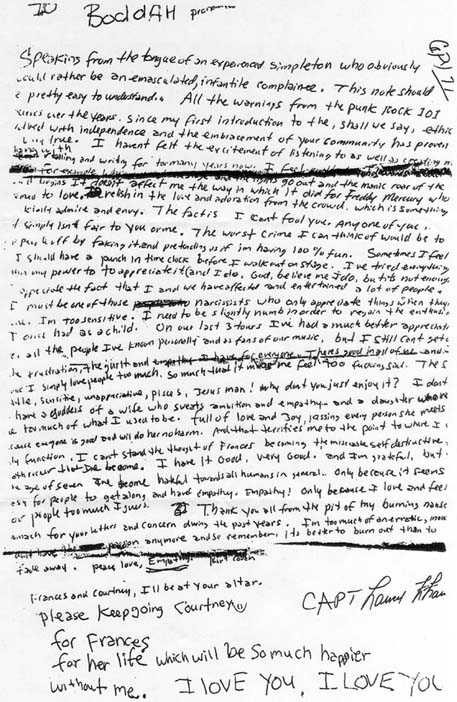 The note that he left behind raises even more questions. First, it reads less like a suicide note than an open apology to fans from a man who’s considering quitting the music business. Here’s an excerpt:
“The fact is, I can’t fool you, any one of you. It simply isn’t fair to you or me. The worst crime I can think of would be to rip people off by faking it and pretending as if I’m having 100% fun. Sometimes I feel as if I should have a punch-in time clock before I walk out on stage. I’ve tried everything within my power to appreciate it (and I do, God, believe me I do, but it’s not enough).”
When he does address his wife and daughter, it’s in the third person. An odd choice for a suicide note. At the end, he quotes Neil Young—“It’s better to burn out than to fade away”—then signs off “Peace, love, empathy.”
There are an additional four lines scrawled at the bottom of the note, in what appears to be completely different handwriting:
“Frances and Courtney, I’ll be at your altar.
Please keep going Courtney, for Frances.
For her life, which will be so much happier without me.
I LOVE YOU, I LOVE YOU!”
While it’s remotely possible that Kurt’s handwriting was affected by the drugs or his mood, there’s something odd in the complete change of tone (and what exactly does “I’ll be at your altar” mean?) Handwriting analysis of the note has been inconclusive.
There are other questions—Why was the ejected shell of the shotgun found to the left and not the right of the body? When Courtney found out that Kurt fled rehab, why did she contact a private eye and not the police first? Why were the private eye and the police told to watch a drug dealer’s house and check hotels for Kurt, but not told that the nanny Michael DeWitt had seen him at the house? Why was a good friend of Courtney Love’s appointed as examining physician?
 Yet another odd twist. In 1996, a punk musician named Eldon “El Duce” Hoke claimed that three years earlier, Courtney Love had offered him $50,000 to murder Kurt Cobain. Hoke even passed an on-screen polygraph test with his claim in Nick Broomfield’s documentary Kurt & Courtney. Eight days after the polygraph test, Hoke was found dead on a railroad track outside L.A.
These unresolved strands have been woven into conspiracy theories that still provoke heated discussion today among fans and friends. Ironically, the one who’s been most outspoken about a murder conspiracy is Tom Grant, the private investigator who Love hired. In 2005, in an interview with Uncut, Cobain’s longtime friend Kim Gordon, of Sonic Youth, said she believed that Kurt was murdered.
It’s clear that Kurt Cobain was thinking about a change of life—quitting the music business, divorcing Courtney Love. Always a reluctant rock star, he was obsessed with his own artistic obsolescence. In the months before he died, he told friends, “I’m just recycled Lennon” and “It’s impossible for me to look into the future and say I’m going to be able to play Nirvana songs in 10 years. There’s no way. I don’t want to have to resort to doing the Eric Clapton thing.”
At the same time, it’s also known that he had a lifelong struggle with depression and drug use. As Cobain’s mother, Wendy O’Connor, told Entertainment Weekly, “Kurt’s problems were ongoing, and we struggled with them for years. I talked him through so many nights. He was probably a mis- or undiagnosed depressive, which runs in my family … The way I explain it is, have you ever been hit in the stomach and lost your breath? It’s a horrible, panicky situation. Can you imagine being in that state of mind—in that state of anxiety and fear—for years? He was a wonderful person, but he just couldn’t stand the pain anymore.”
—By Bill DeMain
From Performing Songwriter May 2006, Issue 93, with stories behind the mysterious deaths of Jim Morrison, Sam Cooke, Jeff Buckley and Kurt Cobain.
Hi-Res PDF of Mysterious Deaths of Rock Icons










0 Comments