
 Songwriter: Richard Berry
Performer: The Kingsmen
Producer: Ken Chase & Jerry Dennon
Released: May 1963
Chart Peak: No. 2 (on the charts for 13 weeks)
Covered by: Second only to The Beatles’ “Yesterday” in the amount of covers, “Louie, Louie” has been cut by over a thousand acts (some existing as bootleg recordings), including The Beatles, The Beach Boys, Jimi Hendrix, Otis Redding, Julie London, Kiss, NRBQ, Lou Reed, The Grateful Dead, Bruce Springsteen, Barry White and Dave Matthews Band.
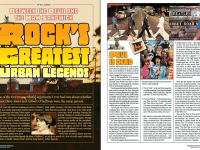
“I would like to see these people—the artists, the record companies and the promoters—prosecuted to the full extent of the law.” These words are from a letter written in February 1964 by an outraged father in Portland, Ore., to then Attorney General Robert F. Kennedy. It was one of thousands of such complaints that poured in to government offices from around the country that year. The source of the outcry? A 45 rpm record that contained a two-and-a-half minute song with three chords, bad diction and a beat borrowed from our Neanderthal ancestors.
“Louie, Louie,” the world’s most infamous party song, began its strange life in 1956. Penned by Richard Berry, a 21-year-old L.A. sideman and songwriter, it was originally conceived as a sailor’s lament, its three verses set to a laid-back cha cha-style rhythm. In Berry’s version, recorded with a group called The Pharoahs, the singer is pouring his lovelorn heart out to a bartender, Louie, about the girl he left across the ocean. The lyric has a sweet Calypso air, with couplets such as “On the ship I dream she there / I smell the rose in her hair.”
The record was a moderate success around the Pacific Northwest, enough that the tune found its way into the live repertoires of several bands. But in 1959, convinced that his song had had its run, Berry sold the copyright for $750 to a publisher named Max Feirtag.
“Louie, Louie” was revived in 1961 by Seattle’s Rockin’ Robin Roberts and The Wailers in a much more raucous version. Again, it failed to become a hit, but it introduced the song’s possibilities to rock groups. In 1963, two Portland-based bands cut “Louie, Louie” at the same studio within days of each other—Paul Revere & The Raiders and The Kingsmen. While both versions had their charms (love those Farfisa organs), the Kingsmen’s was the lucky one.
At the same time it started breaking out as a national hit, the rumors that would fuel the song’s reputation began. As with any urban legend, it’s impossible to trace the origin. But the story was that The Kingsmen’s “Louie, Louie” concealed “dirty” words that could be deciphered only by playing the 45 rpm single at 33 1/3. Like a pre-internet version of the Paris Hilton sexcapade, this notion spread fast and furious. Soon, kids across the country were comparing notes on who was doing what to who in the song.
The lyric was hard to make out. The pidgin English in Berry’s original had been rendered even more incomprehensible by a few factors. The night before they recorded it, The Kingsmen had played a marathon gig, which left lead singer Jack Ely’s voice in ragged condition. In the studio, the boom microphone was fixed too high for Ely, who had to stand on his tiptoes to reach it. His diction wasn’t helped by the braces on his teeth. On top of all that, what the band thought was a rehearsal run-through turned out to be the only take of the song.
The uproar over “Louie, Louie” reached fever pitch in the spring of 1964. First, the song was banned from the airwaves in the entire state of Indiana. And then, stoked by a wave of complaints from parents, teachers and clergymen (where would rock ‘n’ roll be without them?), the FBI began an investigation into the supposed obscene lyrical content. The thought of Hoover’s G-Men bent over hi-fi’s, struggling to decode a half-speed version of the song is comical. Though they would abandon their inquiry a year later, many of the transcriptions of what they thought they heard in the lyric are now declassified government documents (check out www.smokinggun.com). Couplets like “And on that chair, I lay her there / I felt my boner in her hair” perhaps say more about the overworked FBI agents than the Kingsmen.
Richard Berry’s comment at the time was, “If I told you the words, you wouldn’t believe them anyway.”
On Dec. 7, 1963, “Louie, Louie” by The Kingsmen had peaked at No. 2 on the charts (ironically kept from the No. 1 spot by The Singing Nun). But that was only the beginning. The single was re-released for three consecutive years, charting again in 1966. Over the next 10 years, it became the lingua franca of bands around the world.
By 1978, when John Belushi belted it out in Animal House, it had been recorded in over 800 versions and translated into 20 different languages. In 1983, Rhino released The Best of Louie, Louie, a whole record dedicated to one song (Volume 2 followed five years later). By 2000, the song had thoroughly inundated every aspect of pop culture, appearing in over 20 major motion pictures, in TV shows, cartoons and commercials, in novels and nonfiction (rock critic Dave Marsh wrote an entire book about the song), and even in the work of one modern painter. There are several Louie, Louie bars, cafes and restaurants around the world, as well as a mixed drink that bears the name.
Finally, there was a happy ending for songwriter Richard Berry. In 1992, “Louie, Louie” was sold to Windswept Pacific, and Berry regained the rights to the song. The following year, he got his first royalty check for the song, in the amount of $2 million. He passed away five years later.
by Bill DeMain
From Performing Songwriter March/April 2004 Issue 76








0 Comments