

—By Bill DeMain
In November of 1969, Life magazine published a cover feature of Paul and Linda McCartney to put to rest the urban myth that Paul was dead. A reporter went to Scotland to interview them at their farm. At that point the Beatles had broken up, but it was still a secret and wouldn’t be announced for months. But in this interview, which was to address the “Paul Is Dead” fiasco, Paul said “The Beatle thing is over.” And with all the brouhaha surrounding the urban myth, the public and press totally missed the importance of this passing comment.
Here is an excerpt from the 1969 Life interview where Paul talks about the various “death clues” including the OPD badge on his Pepper suit (which fans took to mean “Officially Pronounced Dead”), his black flower in Magical Mystery Tour, and his barefooted appearance on the Abbey Road album cover.
Paul: “It is all bloody stupid. I picked up that OPD badge in Canada. It was a police badge. Perhaps it means Ontario Police Department or something. I was wearing a black flower because they ran out of red ones. It is John, not me, dressed in black on the cover and inside of Magical Mystery Tour. On Abbey Road we were wearing our ordinary clothes. I was walking barefoot because it was a hot day. The Volkswagon just happened to be parked there.”
 “Perhaps the rumor started because I haven’t been much in the press lately. I have done enough press for a lifetime, and I don’t have anything to say these days. I am happy to be with my family and I will work when I work. I was switched on for 10 years and I never switched off. Now I am switching off whenever I can. I would rather be a little less famous these days.”
“I would rather do what I began by doing, which is making music. We make good music and we want to go on making good music. But the Beatle thing is over. It has been exploded, partly by what we have done, and partly by other people. We are individuals – all different. John married Yoko, I married Linda. We didn’t marry the same girl.”
“The people who are making up these rumors should look to themselves a little more. There is not enough time in life. They should worry about themselves instead of worrying whether I am dead or not.”
“What I have to say is all in the music. If I want to say anything I write a song. Can you spread it around that I am just an ordinary person and want to live in peace? We have to go now. We have two children at home.”
Here’s the story surrounding the infamous myth:
Did Paul McCartney die in a car crash in 1966? His mere presence on earth 44 years later, not to mention 25 albums worth of music, touring, another marriage, baby and divorce would seem to suggest the answer is no.
And yet this granddaddy of rock urban legends persists. If you want to see how seriously some Beatles fans take it, direct your browser to www.tlcgraphic.com/paul.html or www.paulisnotdead.com.
The story goes that Paul was killed in a horrific auto accident, beheaded like Jayne Mansfield. The three remaining Beatles and manager Brian Epstein covered up the death, quietly hiring a lookalike named William Campbell to take Paul’s place. At first, fans didn’t seem to notice (especially since the lookalike also conveniently sang and wrote songs like Paul). But the Fabs couldn’t leave well enough alone.
Out of guilt and remorse, they started dropping clues about the singer’s death on their albums. A black armband here, a cryptic license plate there, and backwards messages everywhere. Soon, fans were poring over their Beatles albums for clues.
The urban legend picked up full-steam in 1969, when Detroit disc jockey Russ Gibb aired a call from a local university student who claimed that if you played the spoken title line of “Revolution 9” backwards, it said, “Turn me on, dead man.” He also told Gibb that on the fadeout of “Strawberry Fields Forever,” a voice says, “I buried Paul.” Gibb played both on the air. The phone lines lit up.
With the floodgates open, fans started to find both audio and visual clues everywhere. Here’s a small sampling:
1) “I’m So Tired” – at the end of the song, John mumbles something. When played backwards, it sounds like, “Paul’s a dead man, miss him, miss him.” [It does sound like that.]
2) “I Am the Walrus” – on the fadeout, voices say, “Bury my body,” “O, untimely death” and “Paul, you’re near death … rest you.” [The voices are actually from a BBC radio broadcast of Shakespeare’s King Lear. The first two phrases are from the text, but the last is “Sit you down, father, rest you.”]
 3) Sgt. Pepper’s Lonely Hearts Club Band LP cover – a motherlode of clues. The whole thing is a funeral scene. The headstone is the marble bust to the right of the drum. In front of that is a yellow floral display which can be read as “Paul?” To the right of the bust is a statue of a girl who’s looking down at a flaming car. Paul himself is seen with a hand over his head, which is an Eastern blessing for the deceased … and so on. [Depending on your mood, either preposterous or weird as hell.]
4) Abbey Road LP cover – like Pepper, full of clues. The pose of the four Beatles is symbolic of a funeral procession: John is the preacher, Ringo the pallbearer, Paul the corpse, and George the grave digger. Paul is out of step with the other living Beatles, and has a cigarette—or ahem, coffin nail—in his right hand. [Paul is left–handed.] The VW Beetle in the background has a license plate which reads 28IF. In other words, Paul would have been 28 when Abbey Road was released, if he had lived. [Actually, he would’ve been 27.] On the back cover, a shadow of a skull eyes the band’s name. [Again, far-fetched or freaky, depending on your frame of mind.]
Why did this legend take hold? First, there was a factual precedent—Paul had had a motorcycle accident in 1965, in which he chipped a tooth. Second, analyzing the works of artists like the Beatles, the Stones and Dylan for hidden meaning was part of the late ’60s counter-culture life. Add to that the fact that in late 1969, with the Fabs about to split and Paul newly married, he was keeping a low profile. The mystery reached a fever pitch when Life sent a team of journalists to his farm in Scotland to find him. The resulting cover story was titled “The Case of the Missing Beatle: Paul Is Still With Us.”
Beyond the Paul Is Dead stuff, there are plenty of coincidences and mysteries surrounding the Beatles. The most unsettling is a photo inside the Magical Mystery Tour LP booklet. It shows John Lennon standing next to a sign that reads, “The Best Way to Go is by M & D C.” The initials are the same as those of his assassin, Mark David Chapman. If that’s not eerie enough, Magical Mystery Tour was released on December 8, 1967—an unlucky 13 years to the day that Lennon would be murdered by Chapman.
—By Bill DeMain
From Performing Songwriter Issue 92, Mar/Apr 1996
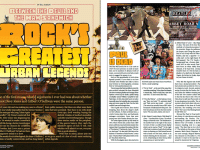
PDF of Rock’s Greatest Urban Legends







0 Comments